Take part in IFOG 2026

As many of you know, the 2026 International Festival of Glass (IFOG) will be taking place in St Helens in Northwest England over the August Bank Holiday weekend (27-31 August), run by the Glass Art Society (GAS) for the first time. Here are more details about some of the glass-related activities that will be on offer as part of this great event, with the masterclass programme just announced, an exciting Contemporary Glass Society (CGS) members’ exhibition, and a Community Mosaic for visitors to contribute to over the long weekend.

CGS A Cabinet of Curiosities exhibition

The CGS IFOG exhibition will be held at The World of Glass under the theme ‘A Cabinet of Curiosities’, which replaces our regular ‘postcards’ exhibition. Members will be invited to submit works of up to 10cm deep by 10cm by 20cm, giving scope for ‘flat’ as well as three-dimensional work this time. Whether you are just starting out with glass or very experienced, you are welcome to submit your work, using any glass technique. As space is limited, you will need to apply for a place.

As CGS Chair, Sarah Brown, notes, “Historically, Cabinets of Curiosities (or Wunderkammer) emerged in Europe during the sixteenth century as rooms or cabinets filled with unusual and fascinating objects collected from the natural world, art, science and exploration. These displays were designed to inspire wonder, spark conversation and celebrate the diversity of the world. We encourage artists to draw upon this rich tradition and their own studio collections, helping to fill our Cabinet of Curiosities with intriguing, playful and thought-provoking glass works.”

Applications are not open yet but start thinking of what you could make and look out for more details of how to apply in the CGS member email newsletters in the coming weeks.

Sign up for masterclasses

Masterclasses at IFOG will be led by experienced tutors, with techniques available ranging from fusing to flamework, and pate de verre to glass blowing. There will also be some suitable for complete beginners.

Already on masterclass lineup are tutors such as Opal Seabrook, who will be

sharing her distinctive fusing style, Brenda Page, who will help students incorporate

images into glass art, and Richard Wheater, who will be teaching neon

glass art. More information can be found on the GAS website now (www.glassart.org/ifog/), including costs, locations, class descriptions, and information on each tutor.

Community Mosaic

Another new aspect of this year’s event is a community glass mosaic project. Led by American glass artist Carrie Strope, the design is being developed in collaboration with local schools and groups. Visitors to IFOG will have a chance to contribute by laying individual pieces and the finished work will be a permanent addition to The World of Glass collection.

Alongside the significant British Glass Biennale exhibition, new this year is that jewellery will be included with beads as part of the International Bead and Jewellery Biennale, plus there will be an international exhibition for GAS members. Applications for these exhibitions have now closed. However, visitors to IFOG will be able to see hundreds of works of contemporary glass from makers in the UK and beyond showcased at The World of Glass and on display until the end of October.

Several organisations are providing awards for artists featured in the exhibitions, including the Guild of Glass Engravers, the British Society of Master Glass Painters, The Worshipful Company of Glaziers, the Bullseye Living Edge Award, The Worshipful Company of Glass Sellers, Warm Glass UK, and more.

There will be demonstrations, presentations, and a range of activities suitable for all ages. Demonstrations will be provided by London Glassblowing, Elliot Walker, and Mattia Salvadore, with more to be announced in due course.

Talks will cover glass art and the importance of glass to the local area. Local St Helens organisations, such as Buzz Hub, Heart of Glass, and the local libraries, are helping to develop ideas and plans. In addition, if you have ideas about a glassy activity or creative opportunity that can be part of the Festival, GAS is keen to hear from you!

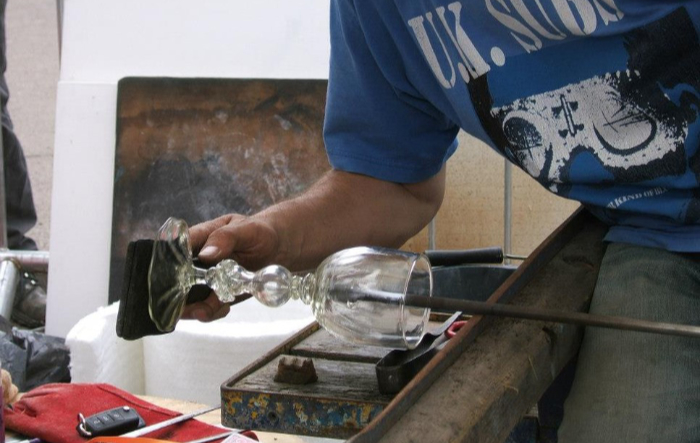
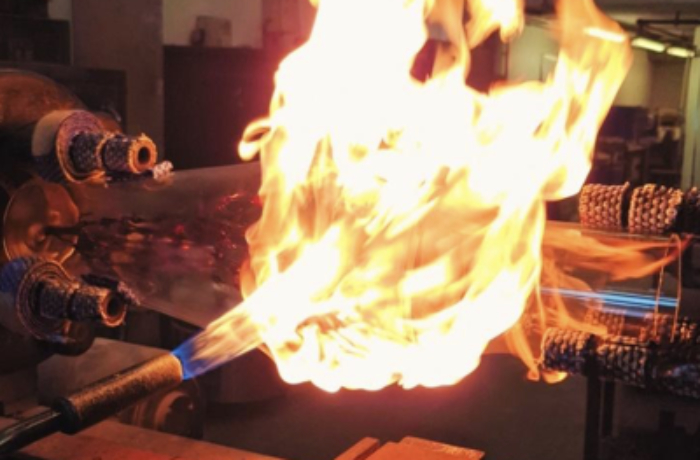
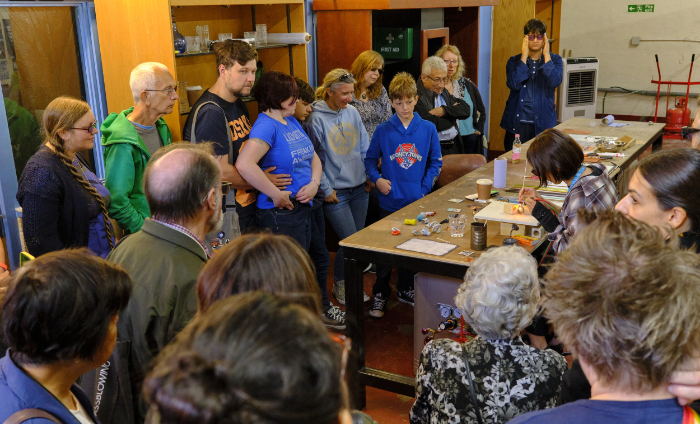
Image: Yukiko Sugano demonstrating her flameworking technique at IFOG 2024.
Glass artists finalists in Loewe Foundation Prize 2026

Glass art is gaining recognition in the prestigious international Loewe Foundation Craft Prize 2026, with four glass artists among the 30 finalists this year.

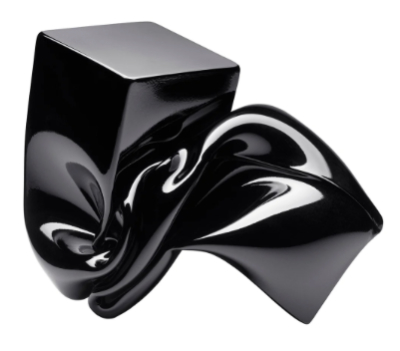
They include Australians Liam Fleming and Kirstie Rea. Liam’s anamorphic glass sculpture is called ‘Patterns of Pressure’. It was made using the traditional Venetian glassblowing technique incalmo, encompassing hot glass mould-blowing and warm glass fusing to create geometric structures that are subjected to high heat in the kiln.

A twisted shiny black glass sculpture bent from a rectangular shape at one end to a tight twist at the other.
Liam Fleming’s ‘Patterns of Pressure’.

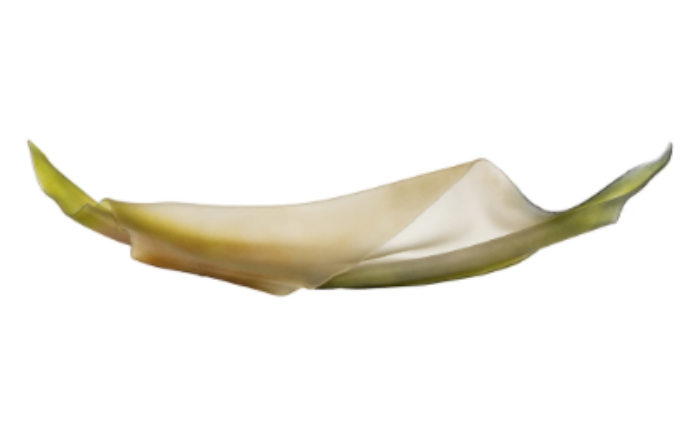
Kirstie’s ‘Repose 2’ (main image) is made from a single piece of glass cut and shaped using traditional tools before undergoing four kiln firings. Coloured powders were added during the first firing, followed by a second firing to corrugate the surface, a third to compress the corrugations, and a fourth the gently bend the sheet into its folded form.

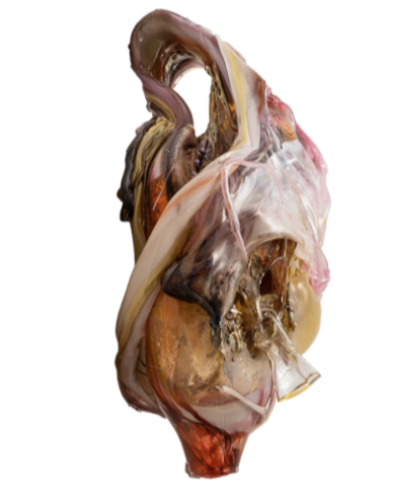
‘Faun’s Flesh (Arena Rosada)’ by Maria Koshenkova from Denmark is made from blown, sculpted glass combined with vintage found glass. Its creation involved multiple blowing sessions, extended kiln firings, cold-working and silvering.


An intricate, vertical glass sculpture that looks visceral and organic in tones of red, orange, cream, brown and white.
‘Faun’s Flesh (Arena Rosada)’ by Maria Koshenkova.

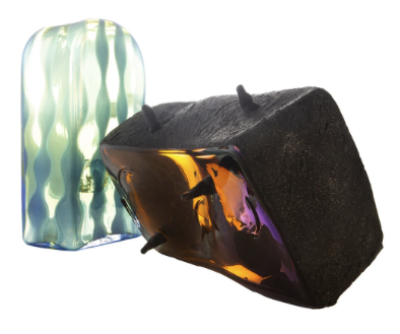
Japan’s Ayano Yoshizumi has created ‘ICON #2507 Group’, comprising ‘ICON #2507 No. 2 and ‘ICON #2304 No. 3’. These pieces, described as “three-dimensional canvases”, feature glass, acrylic paint and glitter. They were hand-blown into static moulds and then shaped and hot torched to give the impression of movement in the glass.

Two brick-like glass pieces in contrast. One is light with an arch shape and tones of wavy green lines running vertically and the other leans horizontally in matt black with splashes of bright colours of orange, yellow and purple, with random spiked areas.
‘ICON #2507 No. 2 and ‘ICON #2304 No. 3’ by Ayano Yoshizumi.

The 30 finalists were selected from over 5,100 submissions from 133 countries and regions around the world.

The overall winner, who will receive a €50,000 award, will be announced on 12 May in Singapore. There will also be €5,000 for any works given a Special Mention.

An exhibition of all shortlisted works will open at the National Museum of Singapore on 13 May.

Find out more about all 30 finalists via this link.

NGC and CGS host glass activity day

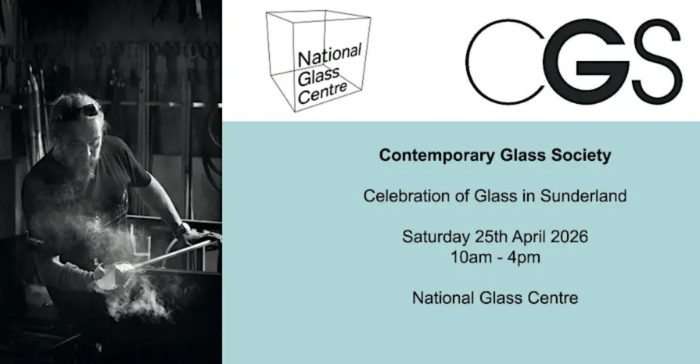
Experience the magic of glass at the National Glass Centre (NGC) on 25 April 2026, where the Contemporary Glass Society (CGS) and NGC will be hosting an exciting day of demonstrations, try-it-yourself activities, glass techniques in action and glass art.

You will be able to have a go at various techniques, as well as watching artists in action. Loads of techniques will be showcased on the day, from glassblowing to waterjet cutting, and you even have a chance to try glass pyrography.

Also, the ‘The Graduates’ exhibition, showcasing work by artists who have studied in Sunderland over the years, will be on display – an experience not to be missed!

The actual events on the day will be finalised nearer the time, but expect collaboration, exploration and a celebration of the glass community.

There is a cafe on site for refreshments too!

So, come along and help us celebrate Glassmaking in Sunderland – it has been there for over 1300 years, and, with the closure of the NGC imminent, CGS would love to have a day of positivity and showcase the magic of glass!

This ‘Celebration of Glass in Sunderland’ is on from 10am to 4pm on Saturday 25 April 2026 at the iconic NGC on the banks of the River Wear. Address: Liberty Way, Sunderland, Tyne and Wear, SR6 0GL.

Tickets are: £20 for CGS Members; £15 for Student Members and £25 for General Admission.

Book now on Eventbrite via this link.

CGS is very grateful to Julia Stevenson, Colin Rennie and James Maskrey at NGC for helping to make this event possible.

We look forward to welcoming you there!

Recycled glass project creates solar concentrators

Many of you will be aware of the work of Ian Hankey in the field of glass recycling, which began back in the early 2000s with an unusual request for a recreation of ancient glass from a materials scientist working at Imperial College in London. She – Dr Sarah Fearn –  was investigating how to stop glass corrosion in some of the ancient glass goblets at the V&A Museum and needed authentically made glass to experiment with. She turned to Ian who was working over the road at the Royal College of Art.

Working with old recipes like the Venetian masters did resulted in a very workable glass and this piqued Ian’s interest in the possibilities for using these methods for upcycling glass today. The idea was to add plant ashes to broken up waste glass from sources that currently cannot be recycled, like windows and solar panels, saving them from landfill. Currently the melting point of these glasses is too high – at 1400-1600°C – and adding the natural materials reduces the melting point.

In due course Ian set up the Upcycled Glass Company and has been working from a studio at Brimpts Farm in Dartmoor, Devon, initially experimenting with bracken harvested on the farm to make bracken ash inspired by a Roman glass recipe.

In a subsequent collaboration, he has worked with Dr Katie Shanks from the Environment and Sustainability and Global Systems institutes at the University of Exeter to upcycle glass from solar panels into a special design of solar concentrator that could provide free power.

Now Ian, whose titles include Sustainable Craft Lecturer and Researcher, master glassmaker, founding father of Fab Lab South West, and Founder and Director of the Upcycled Glass Company C.I.C, has achieved proof of concept on the prototype solar concentrators and is handing his research and methods over to MAKE Southwest, a Devon-based educational charity and contemporary craft centre, to take the project forward.

MAKE Southwest has made a video of a presentation held at Brimpts Farm, called ‘Craft as the Catalyst for Environmental Innovation’, which includes an introduction from farm owner Andrew Bradford discussing how the farm has diversified over the years and was open to supporting Ian’s glass venture. This is followed by Dr Sarah Fearn and Ian Hankey going into a lot more detail about the venture and many of Ian’s other green recycling ideas.

You can watch the YouTube video (filmed by Jordan Kaye and Emily Woollin) via this link.

Image: Ian Hankey creating a goblet using an ancient Venetian glass recipe.

US Museum of Glass renovation to feature Lino Tagliapietra gallery

Washington state’s Museum of Glass in Tacoma has announced a major US$25 million renovation project, starting in Spring 2026.

The museum has been open for 25 years and hosts regular exhibitions, a permanent collection, artists’ residencies in its hot shop, plus educational programmes.

Now it needs to modernise, improve, and expand its gallery spaces to present a more thorough, interdisciplinary perspective on the art form, celebrate its pioneering artists, and exhibit more work from emerging and established artists.

A foundational component of this expansion is a new immersive gallery dedicated to the internationally renowned glass maestro Lino Tagliapietra. A collection of 175 of his works were recently gifted to the Museum by the artist, which will be the foundation of the display.

The Lino Tagliapietra Legacy Gallery will cover approximately 4,000 square feet and enable more than 50 pieces to be on view at any time. It will be the only permanent gallery in the US dedicated to Tagliapietra’s work across his career, from his roots in Murano, Italy, to a focus on the 45 transformative years he spent in the Pacific Northwest, where he inspired and mentored three generations of artists.

Museum of Glass Executive Director Debbie Lenk commented, “This project is essential for Museum of Glass. By expanding our galleries and upgrading critical infrastructure, we will strengthen the Museum for decades to come. The new state-of-the-art galleries will showcase exhibitions that highlight the story of glass art and artists from the Pacific Northwest, as well as works by artists worldwide. We are particularly excited to unveil a gallery celebrating the incredible legacy of Maestro artist Lino Tagliapietra.”

The work is expected to take six months to complete, and the non-gallery spaces will remain open during this time.

“Alongside the Lino Tagliapietra Legacy Gallery, our new space will give us new opportunities to showcase the Museum’s world-class collection and invite visitors into the still-evolving story of glass art. Behind-the-scenes improvements like lighting and HVAC are critical to the care of our growing collection and will create a dynamic backdrop for the artwork in our galleries,” said Museum of Glass Curator Katie Buckingham.

Museum of Glass is at 1801 Dock Street, Tacoma, WA 98402, USA. https://www.museumofglass.org

Image: Lino Tagliapietra demonstrating his glass talents at Museum of Glass, where he completed 19 residencies in the hot shop. Photo courtesy Museum of Glass.

Imagining a better world

What do you do when your children tell you there is too much glass art on display at home? US-based prolific glass artist, collector and entrepreneur Trish Duggan decided the answer was to open a museum. Linda Banks finds out more.

You are an artist, entrepreneur and philanthropist. What led you to start working with glass?

When I saw a sculpture that seemed to have so much energy reflecting off it, I asked what material was used to create it. The answer was glass! I became a collector of glass sculptures and was then asked if I wanted to see how these cast glass pieces were created. I was thrilled to have the opportunity and so mesmerised with what I imagined was molten lava that I asked if I could make a piece.

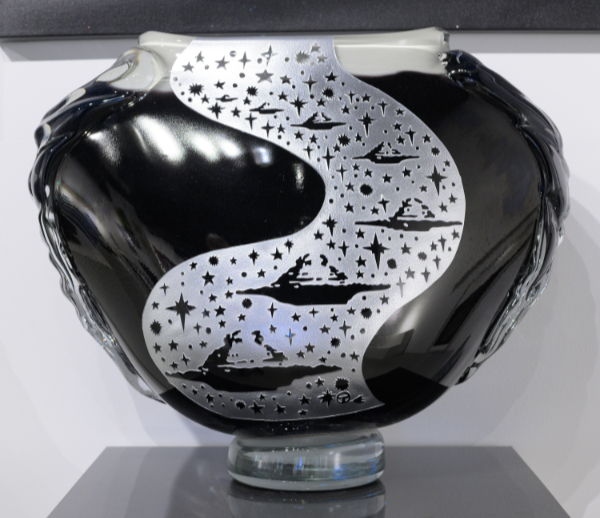
A black rounded glass vase with a design of UFOs ranging from tiny to larger on a wavy white line suggesting they are travelling forward.
‘Just Visiting’ is an example of Trish Duggan’s fascination with UFOs.

What glass techniques have you used, and which do you prefer?

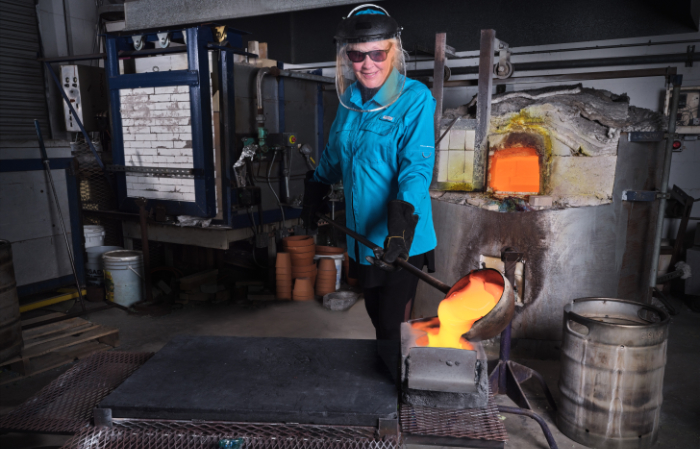
The technique in glass that I prefer is glass casting. I’m the only artist who carves a wood block, makes several prints and then presses that woodblock into sand or ground up olivine. Then I ladle the 2,100°F glass into that indentation after coating it with acetylene using a torch!

I also enjoy fusing four panels of glass together. They are then etched with various artistic themes and even quotes to inspire the observer. For example, in the museum I opened there is an entire wall full of fused glass panels of famous women with famous quotes.

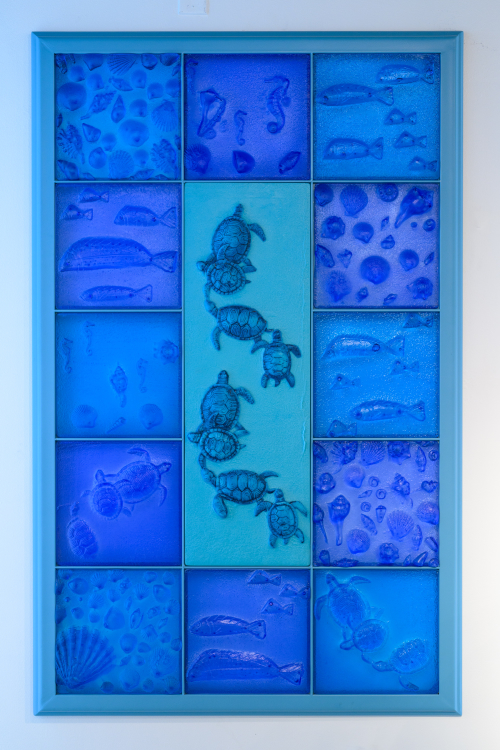
A vertically rectangular blue glass panel made up of lots of squares of glass with different underwater themes. In the centre is a smaller vertical rectangle panel featuring swimming turtles.
‘Sealife’ was made with Trish’s daughter, Diana Duggan.

You realised your vision of founding the Imagine Museum of Contemporary Glass Art in Florida, USA. What drove this ambition and were there challenges along the way?

I opened Imagine Museum after I had adopted six children – most out of foster care – and my five boys told me I had too much glass in the house! I joked with them and said, “Well, ok, then I think I’ll have a museum!” They were rolling on the floor laughing and telling me what a wild mom I was. Two weeks later, I purchased an abandoned charter school and turned it into a contemporary glass museum. I’ve received the Tampa Bay Magazine “Museum of the Year” award for 2024 and for 2025!

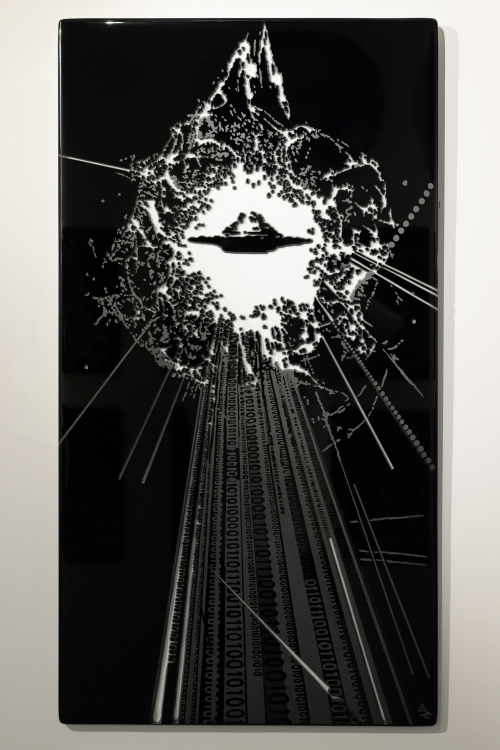
A dramatic artwork featuring a UFO saucer against a white background and beams of light all against a black rectangular background.
‘Break Through’ by Trish Duggan.

Please tell us more about your creative approach. Do you draw your ideas out or dive straight in with the materials?

I spend time drawing every week! My mind is like a hurricane continuously full of artistic ideas. I work with an incredible team, including Sam Brewster and her daughters Casi and Brittany, and others!

What message(s) do you want to convey through your art?

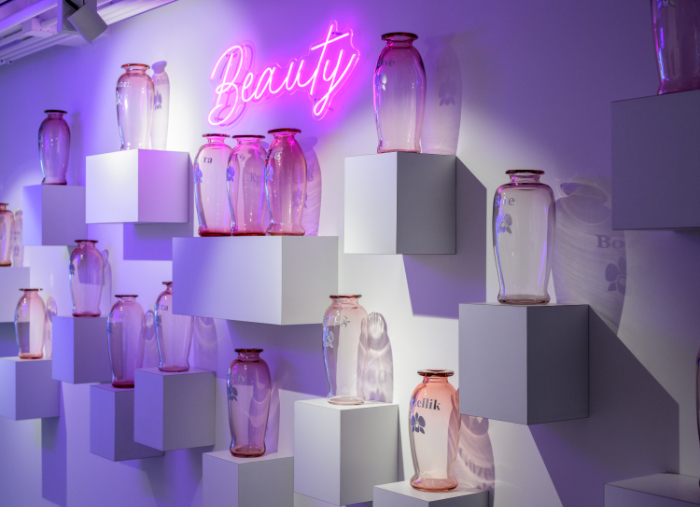
I convey many messages through my glass art! I have an entire hallway of glass vases etched with the words serenity and beauty in 24 different languages. I truly believe that every single person from any different background can experience beauty and serenity!

Blown glass vases on cube wall plinths saying the word beauty in 24 languages. Above is a neon sign reading Beauty in pink. By Trish Duggan.
‘Beauty’ vases saying the word ‘beauty’ in 24 languages.


What is your favourite tool or piece of equipment and why?

My favourite tool is the ladle for scooping and pouring the red-hot glass. In Sweden, where I collaborated with Bertil Vallien, the most famous cast glass artist, his team lifted the ladles up high in the air and clanked them together before casting!

Trish Duggan wearing a fireman's mask and holding a large ladle to pour molten glass into a mould at Sigma Studio.
Trish Duggan glass casting at Sigma Studio wearing her fireman’s mask.

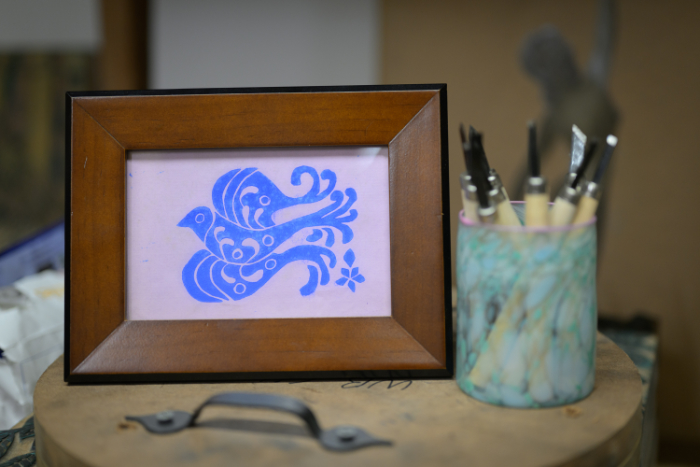
Of course, I also love my Japanese carving tools that I began using in high school. My Japanese art teacher gave me a blue ribbon for all my woodblock prints. Now I have made 24 different flower prints and each has a blue glass window to match it.

A framed woodblock print of a bird next to Trish's Japanese carving tools.
Trish’s first woodblock print (made age 16) alongside her carving tools from Japan.

Do you have a favourite piece or collection you have made? Why is it your favourite?

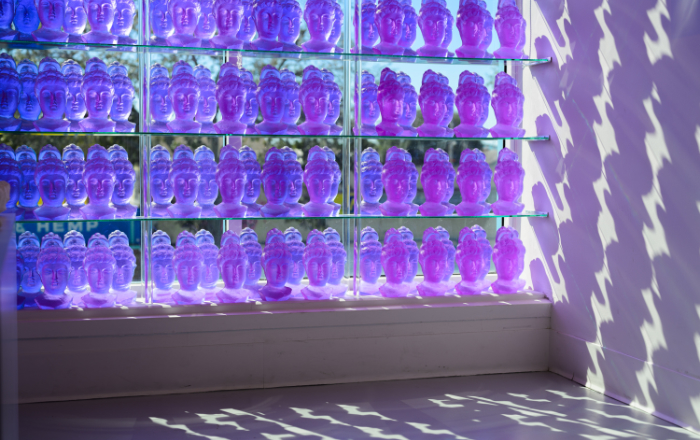
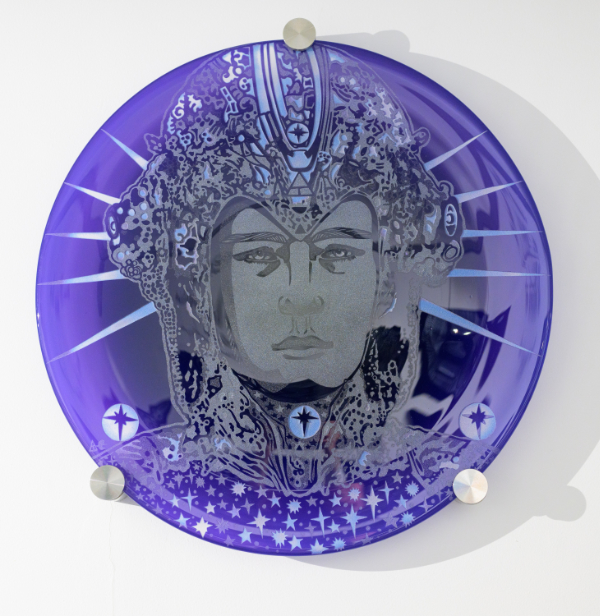
A circular purple glass wall panel featuring an alien being's head by Trish Duggan.
‘Interstellar Astrophysicist’ wall panel.

My current favourite collection I’ve created is my 1,000 alien series, which is made in glow-in-the-dark uranium glass! The former head of the Department of Defense from Canada, Paul Hellyer, stated publicly that “we’ve known that four races of aliens have been visiting Earth for thousands of years”. I created four races of aliens! I’ve also done 70 black-and-white fused and etched glass panels of UFOs. It’s time for DISCLOSURE! I have had an experience with a UFO!

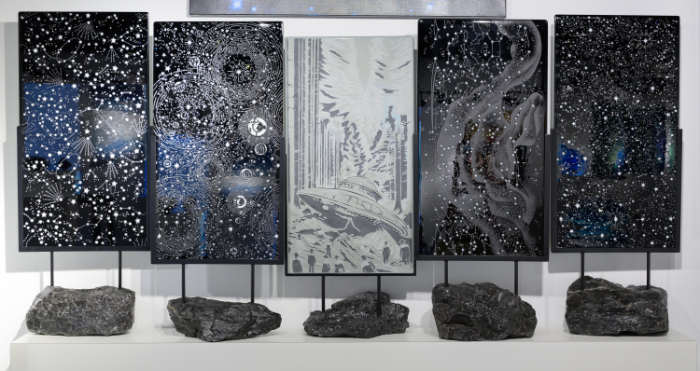
A series of 5 space-themed glass panels mounted on rocks.
‘Unfortunate Accident’ features space and UFO themes.

Where do you show and sell your work?

I show and sell my glass creations at my museum. I also show my work in the US Embassy in New Delhi, India, and several buildings in Washington DC.

Do you have a career highlight?

The highlight of my artistic career was when my boys told me I had too much glass in the house and I joked with them about opening a museum. Then, two weeks later, I signed on the line at a bank and purchased that charter school that had closed. I turned it into a unique and thrilling museum highlighting more than 150 American glass artists. The purpose is to uplift and inspire all who come for a visit. The most exciting aspect of the museum project was that I was able to design it myself and choose the stunning collection for others to enjoy.

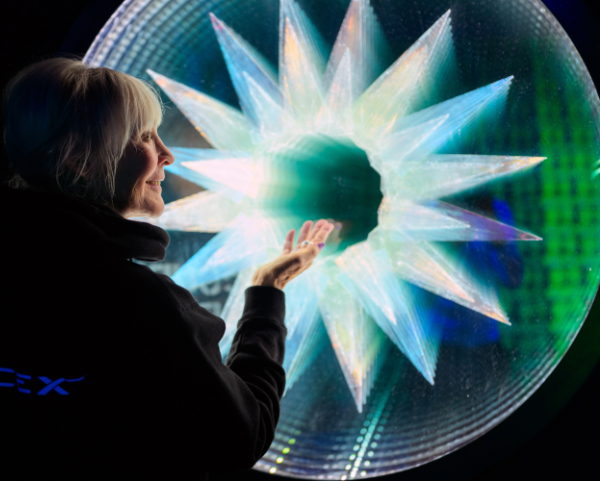
Trish Duggan rear view pointing out a large layered glass artwork in front of her called 'Star Gate Exit Portal Planet Earth' which looks like a white star shape with a hole in the centre suggesting a tunnel.
Trish Duggan with artwork ‘Star Gate Exit Portal Planet Earth’.

Where is your creative practice heading next?

My creativity is never ending! I am overloaded with spectacular ideas. I am currently working on a series of Presidents and American icons. I’m also making a series of angels. After that, I will make a series of glass cubes with flowers, leaves and vines for a show in Costa Rica where we will be building the Peace Museum dedicated to Nobel Peace Prize winners. My goal is to inspire people to think about how they can create peace in the world by starting with creating peace in their own lives!

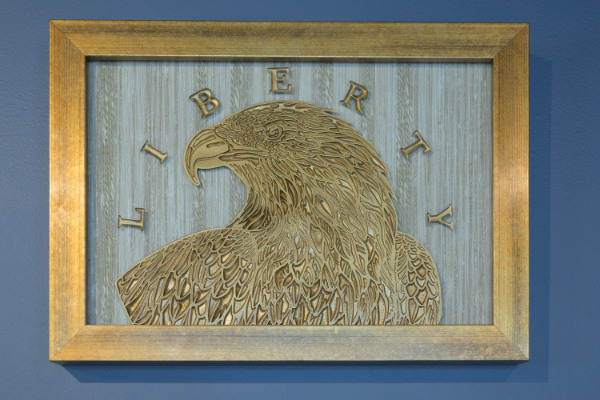
A golden eagle with the word Liberty around it and all framed in a gold frame.
‘Liberty Eagle’ is part of a recent series featuring American icons.

And finally…

From my personal viewpoint, I think it is extremely important for each person to find their creative expression. One of my favourite quotes is from Albert Einstein, who stated, “Imagination is more important than knowledge”. Let’s all imagine a future full of compassion, understanding, love and peace!

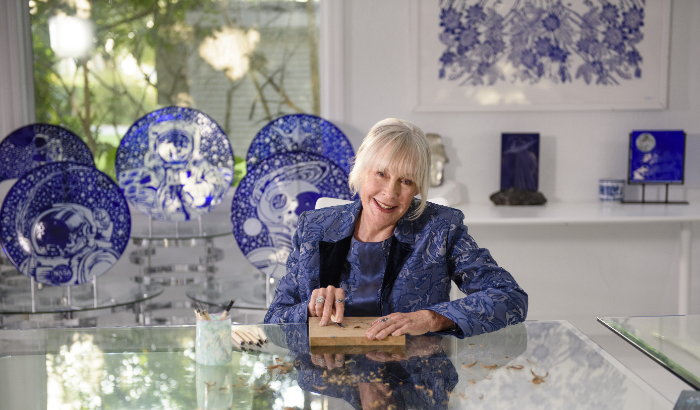
Trish Duggan carving woodblock seated at a table with assorted blue-and-white glass panels on display in the background.
Trish Duggan carving a woodblock with examples of her glass art in the background.

Find out more about Trish Duggan and her artistic practice via her website.

Main feature image: ‘Goddess of Compassion Wall’ by Trish Duggan. All images courtesy of the artist.

Open letter in support of Glassworks: Sunderland

Sarah Brown, Chair of the Contemporary Glass Society (CGS), explains why CGS is supporting the new facility for glassmaking in Sunderland.

You may be aware of the current situation for glassmaking in Sunderland, and the planned closure of the National Glass Centre (NGC), which has been heavily disputed since it was announced.

Glassmaking has been in Sunderland for over 1350 years and, as an important part of culture in the Northeast of England, we believe that there should be the facilities for this key part of the area’s heritage to continue. Many, many well-known artists and glassmakers have studied, learned and practised their craft here for so many years, and a facility needs to be available for this to continue in the years ahead.

We are supporting this open letter (see link below) for Glassworks: Sunderland, as, although none of the 204 signatories agrees with the closure of NGC, it is important that the possibility of glassmaking continuing in Sunderland is supported.

This new facility has the opportunity to secure considerable funding, which would enable glassmaking to continue in the near future. With the planned closure of the NGC moving ever nearer, in the face of such uncertainty, the artists, makers and educators in Sunderland need the support to continue their practice going forward, and a viable option has been proposed.

Sarah Brown, CGS Chair

Open Letter in Support of Glassworks Sunderland_4978401744719160154

Showcase rare glass skills at Endangered Crafts exhibition

A new exhibition featuring endangered glass crafts will be held at Stourbridge Glass Museum later this year (11 July-7 November 2026). Glass artists working with heritage techniques are invited to submit work for this major group exhibition, which is supported by Heritage Crafts (the UK’s national charity for traditional heritage crafts) and the Contemporary Glass Society (CGS).

Using the Heritage Crafts Red List of Endangered Crafts as a guiding framework, the ‘Endangered Crafts’ exhibition will showcase contemporary glass artists working within traditions that are at risk of being lost, alongside work that reflects on the importance of preserving specialist craft knowledge.

The glass crafts listed on the Heritage Crafts Red List include:

Extinct in the UK:

Mouth-blown sheet glass making

Critically Endangered:

Copper wheel glass engraving

Glass eye making

Cut crystal glass making

Endangered:

Scientific glassblowing

Neon making

Reverse glass sign painting

Brilliant cutting

Stained glass window making.

In addition, artists working in related endangered glass techniques are welcome to apply, where they can provide supporting information to demonstrate why their craft should be considered at risk.

Artists may submit up to three works for consideration for this selected show. Works may be for sale (the museum takes a 30% commission).

The exhibition will be accompanied by a programme of talks and demonstrations during the opening weekend.

The submission deadline is 31 March 2026, with successful artists notified in late April/early May. Artists may submit up to three pieces for consideration for a £15 administration fee.

Selected artists may also have the opportunity to take part in live demonstrations during the exhibition opening weekend, offering audiences insight into endangered glassmaking techniques.

Find out more and submit work via this link.

Dutch Glass Biennale returns to Amersfoort

After the success of its first edition in 2024, The Dutch Glass Biennale, ‘Living the Glass Age’, returns to Eemklooster (a former monastery) in Amserfoort, the Netherlands, from 20 March to 12 April 2026.

This is the only nationwide art biennale in the Netherlands dedicated to glass in contemporary art. A new generation of national and international artists is set to demonstrate how glass continues to evolve as an innovative and boundary-pushing medium within contemporary art.

The organisers say that Living the Glass Age is not a traditional exhibition, but a platform for experimentation, innovation, and artistic freedom. From delicate sculptures to monumental installations, the biennale showcases the versatility and expressive power of glass while highlighting current developments in glass art. The event is aimed at a broad audience of art lovers, makers, students and interested visitors.

While glass is often associated with functional objects, Living the Glass Age reveals the material’s radical artistic possibilities. Artists work with techniques such as pâte de verre, glass bonding, flameworking, and glass engraving, opening up new visual and conceptual dimensions.

Alongside the exhibition a complementary in-depth programme of events features demonstrations and explanations of these techniques, allowing visitors to not only observe the works but also to gain insight into the creative process.

The 2026 edition will showcase the work of 31 professional artists. After an exclusively Dutch edition in 2024, the biennale takes on a distinctly international character this year. Participants include artists who are still relatively unknown in the Netherlands but enjoy major international recognition, such as the Verhoeven Twins and Winnie Teschmacher, whose work is in leading museum collections worldwide.

In addition, Krista van Norel has created a new, unique artwork especially for Living the Glass Age, which will be unveiled during the opening ceremony.

The educational program has been expanded significantly this year, too. Pupils and students from primary education, secondary education, and vocational education will work with glass in workshops and interactive programmes. There will also be artworks in the show made by academy students, demonstrating how the event is investing in the future of glass art and inspiring a new generations of makers.

Living the Glass Age, the Dutch Glass Biennale 2026 takes place at Eemklooster, Daam Fockemalaan 22, 3818 KG Amersfoort, The Netherlands. For further information see the website: www.livingtheglassage.com

Image: ‘High voltage waggle dance’ by Stef Veldhuis will be displayed at the exhibition. It uses VLF sound recordings within the glass pods.

Playing with sand like a child

Jan Hooghiemstra’s glass work presents a dreamlike world of symbolic images created in sand moulds. Here he outlines his inspirations and showcases pieces that he creates in an uninhibited way, like a child transforms wonder and fantasy into forms.

I first discovered the world of glass art almost 50 years ago, when we took a holiday in Scandinavia with a VW van converted into a camper. On one of our trips we discovered Glasriket, an area in southern Sweden with several glass factories and workshops. Once I visited the glass factory of Kosta Boda, I immediately fell in love. The hot mass of glass was transformed into sculpture – from lava to ice.

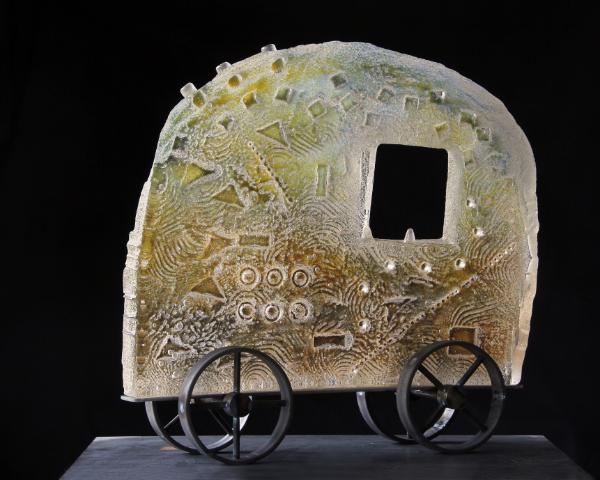
Caravan-style cast glass vehicle with steel wheels called Get in and join us on the journey.
Get in and join us on the journey. In this way, memories are collected that are visible in the glass. Sand-cast glass with steel wheels underneath.

What a fascinating material. It was not the glassblowers who made a deep impression on me, but the material they worked with. At that point I knew for sure that I wanted to do ‘something with glass’. It took a while before I knew exactly what direction I wanted to take with it. It was the Swedish glass artist Bertil Vallien who showed me the way. Vallien is a pioneer of the sandcasting technique. The combination of glass and sand fits me like a glove. It is a technique that makes me feel like a child again, playing in sand.

This sand-cast piece is like an unborn child with its own unique characteristics.

Bertil Vallien is my great inspiration. During ‘Kunstmaand Ameland’ (Ameland Art Month) I visited an exhibition of his and tears flowed down my cheeks. Pure emotion. Glass artist Vallien is a master of shaping sand moulds and then filling them with glowing glass. In addition, Nina Casson McGarva, from England, motivates me. What appeals to me so much about her work is that halfway through the firing process she takes the glass out of the kiln and manipulates it manually. Then the glass is put back in the kiln to cool slowly.

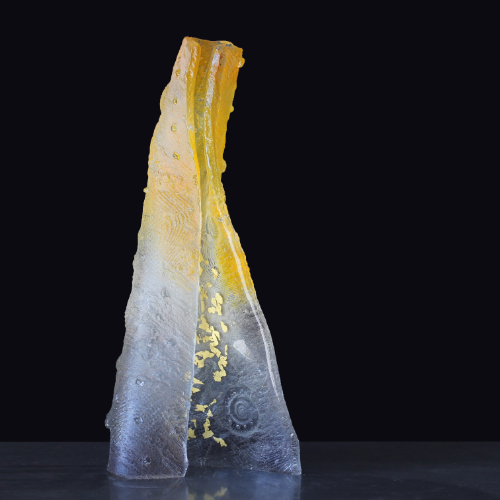
A vertical sand-cast glass sculpture with gold foil fused into it, distorted by hand-manipulation outside the kiln during the firing process.
This sand-cast glass sculpture has gold foil fused into it. It was removed from the kiln during the firing process to be shaped by hand.

I chose to work with glass as a material because it is so fascinating and at the same time so unruly. It is amazing to be able to heat the hard glass into a hot liquid mass that can be formed and becomes hard glass again on cooling. Sometimes I wonder if the glass doesn’t control me instead of the other way around. Working with glass requires respect and reverence for the material above all.

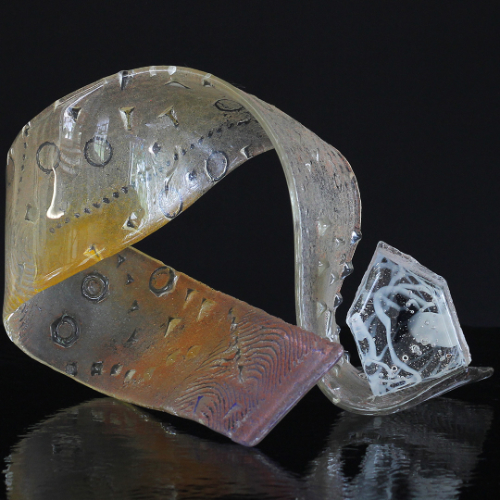
A twisted thin strip of decorated glass with a house shape at the bottom. It represents life as a rollercoaster, but with a safe home base. The glass was removed from the kiln during firing for manipulation.
Life is a rollercoaster, but fortunately there is also that safe home base: our house. The glass was sand cast and removed from the kiln during the firing process to manipulate it manually.

My method involves heating the glass in one of my glass kilns. This kiln is filled with sand; a sandbox in which I can play like a child. In this joyful way, a negative mould is created that is later filled with liquid glass. Above the mould are flowerpots that contain chunks of glass that liquefy during the heating stage and pour out through the holes in the bottom to fill the mould. This process does require some careful calculations. I have to calculate in advance exactly how much glass is needed to fill the mould. I must also work out how long I should allow until I can open the kiln, remove the flowerpots and deform the glass by hand. These calculations are difficult and not the most fun part of the process. My patience is also tested when it takes days for the glass to cool down until the kiln can finally be opened.

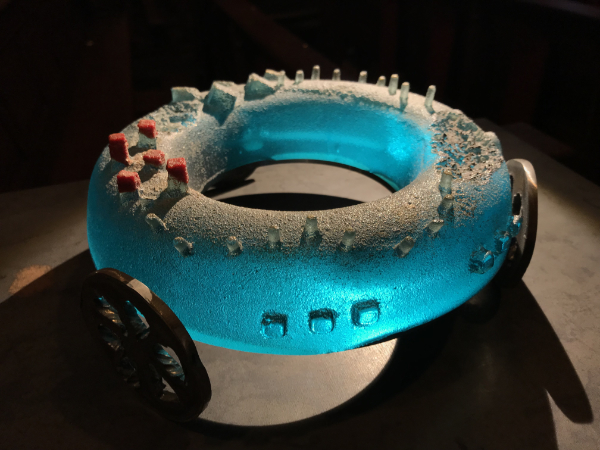
This donut-shaped sand-cast glass piece has small shapes on the top and three steel wheels.
‘Carry on: like life itself? Faster and faster. Sometimes hard to stop.’ Sand-cast glass with steel wheels.

What constantly intrigues me in my glass practice is movement; everything is always in motion. In this respect, I am thinking not only of means of transport but also of the blood that flows through the body, the Earth that rotates, and nature that grows. In addition, I love the pure human being – the person who does not pretend to be better than he is but is content just as he is. Both subjects are important in my artworks.

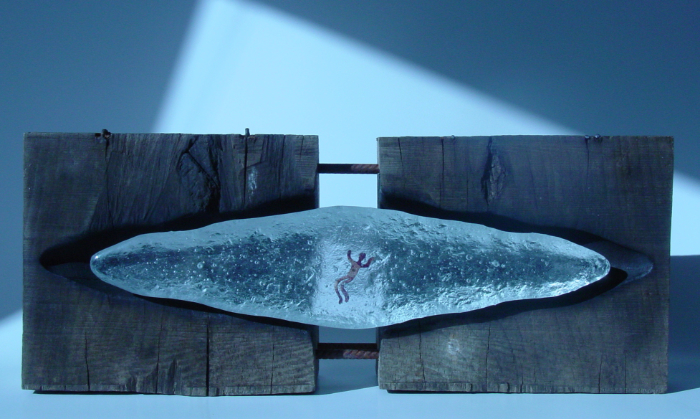
An old glass mould supports clear sand-cast glass featuring a swimming figure in the centre made from copper. The pure human figure swims uninhibited in the glass 'sea'.
A pure human figure swims uninhibited in a sea of sand-cast glass held together by an old glass mould. The figure is made from copper.

At the moment my work is being exhibited in Bulgaria and I am preparing a mirror project in a public space: Where reality meets illusion.

Find out more about Jan via his website: https://www.janhooghiemstra.nl/glaskunst/

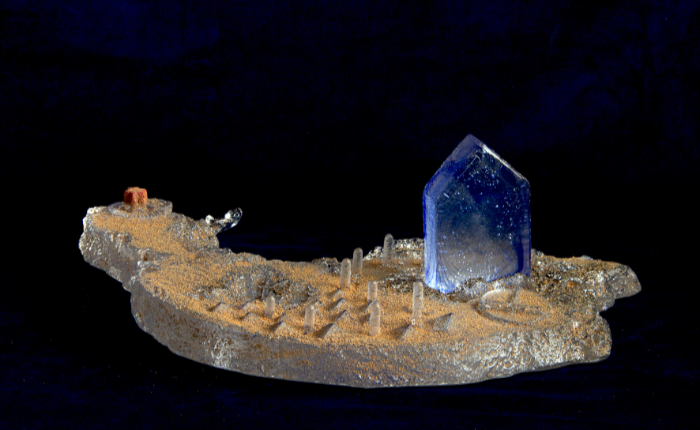
Main feature image: This sand-cast glass piece comprises an uninhabited island floating in space with only a small empty house on it. It deliberately leaves a lot to the viewer’s imagination. All photos by the artist.